Home Builders' Guide: What Acoustical Plaster Is and How It Works
Section 2 of the Home Builders' Guide to Acoustical Plaster

Section 2 of the Home Builders' Guide to Acoustical Plaster
Acoustical plaster is a multi-layer, monolithic finish system that integrates sound absorption directly into the architectural surface. Once installed, it presents as a continuous, seamless wall or ceiling finish, indistinguishable by eye from conventional plaster, while delivering certified acoustic performance across a broad range of frequencies.
The distinction from earlier-generation acoustic products is fundamental. Foam tiles, fabric-wrapped panels, perforated ceiling modules, and suspended baffles all announce themselves. Their acoustic contribution is legible because their presence is visible. Acoustical plaster works on an entirely different premise: the treatment is the surface.
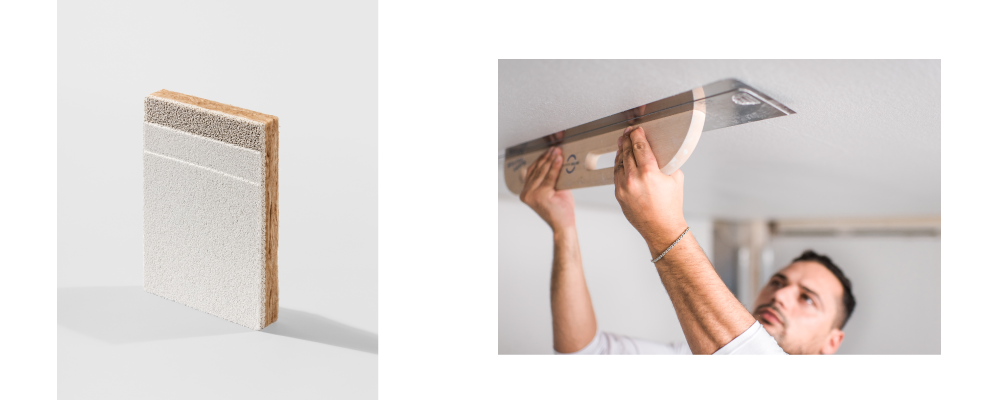
A complete acoustical plaster installation is composed of three integrated components.
The substrate panel forms the acoustic core of the system. Engineered mineral wool, spun into a randomly oriented fiber matrix, creates the structural and acoustic foundation. This randomly spun architecture is what gives mineral wool its capacity to absorb sound across a wide frequency range: the irregular fiber orientation captures both high-frequency and low-frequency energy through different physical mechanisms, and neither requires visible surface treatment to function.
High-frequency sound energy, including speech and the fundamental tones of most musical instruments, passes through the microporous finish surface and enters the fiber matrix of the panel, where it is converted to a negligible quantity of heat through friction. Low-frequency energy, including bass tones, room modes, and mechanical vibration, causes the plaster finish itself to flex diaphragmatically against the mineral wool panel, converting that energy to heat through a spring-mass mechanism. This dual absorption addresses the full acoustic spectrum that matters in residential settings, from the upper frequencies of conversation to the lower frequencies of music and mechanical systems.
The panel arrives factory-coated and precision-sanded, with heat-bonded construction that prevents delamination. Beveled panel edges eliminate the need for tape or adhesive at seams. After installation, seams are filled with acoustically transparent material, and the finish coat is applied across the entire surface, creating a monolithic result with no visible joints or discontinuities.
The finish coat is applied by hand trowel or spray, depending on the texture and effect desired. It is composed of marble aggregate, a byproduct of the stone extraction industry, available in grain sizes from 0.5mm (a refined, nearly smooth surface comparable to fine Venetian plaster) to coarser aggregates that open the range of achievable textures considerably. The aggregate is inherently dense and durable, carries no VOCs, and is available in any custom color without any loss of acoustic performance.
Acoustic absorption in surface materials is quantified by the Noise Reduction Coefficient (NRC), a metric defined by ASTM C423, the Standard Test Method for Sound Absorption and Sound Absorption Coefficients by the Reverberation Room Method. The NRC represents the arithmetic average of a material's sound absorption coefficients at four frequencies: 250 Hz, 500 Hz, 1,000 Hz, and 2,000 Hz, the range that encompasses the primary frequency bands of human speech. Values range from 0.00, which describes a perfectly reflective surface such as polished stone, to 1.00, which represents complete absorption.
For context, standard interior gypsum wall board measures approximately NRC 0.05. Heavy drapery measures approximately NRC 0.55. A well-specified acoustical plaster system achieves the following, all confirmed by independent third-party laboratory testing under ASTM C423:
All NRC values per independent ASTM C423 third-party laboratory testing.
The 70mm system's rating of NRC 1.00 warrants particular attention. In ASTM C423 testing, a result at or above 1.00 can occur due to edge diffraction effects and is accepted as the upper bound of the scale rather than a mathematical anomaly. It indicates that the material absorbs all measurable incident sound energy within the tested frequency range, a performance threshold no competing acoustical plaster product currently matches in certified testing.
Beyond NRC, builders specifying for music rooms, home theaters, or spaces adjacent to mechanical systems should also consider low-frequency performance. The ASTM C423 measurement range begins at 250 Hz, which excludes the low bass frequencies where room modes and mechanical noise are most problematic. The diaphragmatic absorption mechanism of the thicker panel systems addresses energy in the 80 to 200 Hz range that NRC does not capture, making a full one-third octave report the preferred specification tool for critical acoustic environments.
An additional performance dimension relevant to residential construction: acoustical plaster systems contribute 5 to 7 additional points to a wall or ceiling assembly's Sound Transmission Class (STC) rating, as defined by ASTM E90. STC measures a material's resistance to airborne sound transmission between spaces, a key metric for master suites, home offices, and any room requiring acoustic separation from adjacent activities.
Section 1: Introduction: The Missing Dimension in Residential Design
Section 2: What Acoustical Plaster Is and How It Works
Section 3: Where Acoustical Plaster Belongs in a Residence
Section 4: Design Flexibility for Surfaces That Perform and Persuade
Section 5: A Builder's Perspective to Installation, Coordination, and Timeline
Section 6: The Value Case: Immediate, Long-Term, and Lasting
Section 7: How to Introduce Acoustical Plaster into Your Specification
Connect with our skilled network of certified installers
BASWA's network of certified installers is available throughout the world. Contact the installer in your project location.
