Home Builders' Guide: Where Acoustical Plaster Belongs in a Residence
Section 3 of the Home Builders' Guide to Acoustical Plaster

Section 3 of the Home Builders' Guide to Acoustical Plaster
The starting point for any conversationabout acoustical plaster in residential design is a realistic assessment of howthe acoustic environment of a home actually performs. This requires thinkingthrough the specific geometry, material palette, and use patterns of each majorspace, and recognizing that the architectural choices that make a home visuallyextraordinary often create the conditions most demanding for acousticmanagement.
High ceilings amplify vertical reflections.Open plans allow sound to travel freely between functions that would benefitfrom separation. Hard, polished surfaces, including stone floors, glass walls,lacquered millwork, and concrete, are acoustically reflective by definition.The features that give a luxury residence its distinctive spatial quality areprecisely the ones that make untreated interiors acoustically challenging. Thisis not a problem to be apologized for; it is a design reality that informs specification.
Open-plan living spaces with volume ceilings and hard surface palettes are the acoustic environment most commonly encountered in contemporary luxury residential design, and among the most demanding to resolve. In an untreated great room with parallel surfaces and ceilings above twelve feet, reverberation times routinely reach 1.5 to 2.5 seconds at the 500 Hz center-of-speech frequency, a range confirmed by acoustic modeling studies of similar geometries. At these reverberation levels, speech intelligibility degrades measurably within large conversational groups, and the cumulative effect of overlapping conversations during social gatherings creates a noise floor that forces progressive escalation of voice levels.
Published research in the journal Noise and Health has documented that extended reverberation time independently affects cognitive load and emotional response, with longer reverb times correlating with increased listener effort and diminished enjoyment of both speech and music. For clients who invest in their entertaining environments, this represents a quality deficit that no visual specification can compensate for.
Acoustical plaster applied to the ceiling plane of a great room, or to the upper wall surfaces above the millwork line, can reduce reverberation to a target of 0.5 to 0.8 seconds, a range in which speech remains fully intelligible, music retains appropriate spaciousness, and the room functions at the level it was designed to.

This is the application in which the performance advantage of acoustical plaster over panel-based acoustic systems is most immediately apparent to clients and most demonstrable to builders.
A properly functioning home theater requires broad-spectrum absorption that extends well into the low-frequency range, below 250 Hz, where room modes create bass buildup that no equipment upgrade can correct. The coloration introduced by untreated low-frequency room modes is audible regardless of the quality of the speaker system: specific bass frequencies are reproduced at inflated levels relative to the signal, and others are suppressed, creating a form of distortion that is endemic to the room rather than the source. The 70mm panel system addresses this through diaphragmatic absorption, without requiring the addition of conventional bass traps or treatment that would alter the visual character of the space.
Equally important for building code and client confidence: acoustical plaster carries a Class A fire rating, the highest classification under ASTM E84 for surface burning characteristics. In a room containing significant electronics and projection equipment, this is not a nominal distinction.
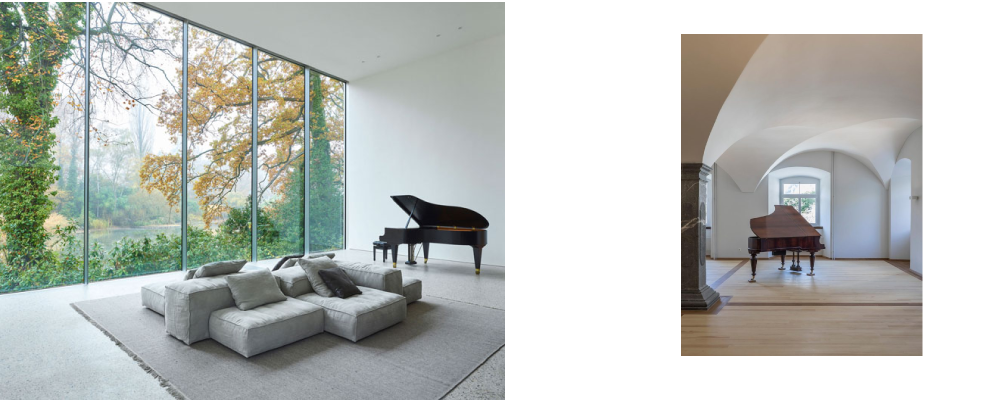
Among the most acoustically demanding residential commissions is the dedicated music room, whether intended for a client who plays seriously, one whose children are studying, or one who requires a space for critical audio reproduction. The room is the final component in any audio or musical chain: its geometry, surface materials, and absorption characteristics determine the accuracy with which music is reproduced or performed.
Acoustical plaster allows a music room to be built to professional acoustic standards while maintaining the interior quality of the finest residential finishes. Custom textures can replicate limestone, aged plaster, or smooth stone without any compromise to the acoustic performance of the system beneath. The room performs as designed; it also looks like the house it belongs to.
The relationship between acoustic environment and sleep quality is one of the most consistently documented findings in environmental health research. A meta-analysis published by researchers drawing on World Health Organization systematic reviews confirmed that nighttime noise is a significant contributor to sleep disturbance, and that sleep disturbance in turn is associated with measurable impacts on cardiovascular function, metabolic regulation, and cognitive performance over time.
For primary suites in urban locations, near airports or major roadways, or adjacent to the mechanical infrastructure of large residences, acoustic treatment of the ceiling and upper wall surfaces contributes to both reduced internal reverberation and an overall increase in the acoustic mass and damping capacity of the room envelope. The National Sleep Foundation has identified a quiet, dark, and temperature-controlled bedroom environment as the three most important factors in sleep quality, a finding consistent across multiple demographic groups.
There is also a more experiential dimension worth noting: clients who have stayed in the most refined hotel suites, where ceiling treatment with acoustical plaster has been standard practice for two decades, return with a specific memory of that quality of quiet. They often cannot name the specification. They can describe the feeling of the room. That quality is reproducible in residential construction.
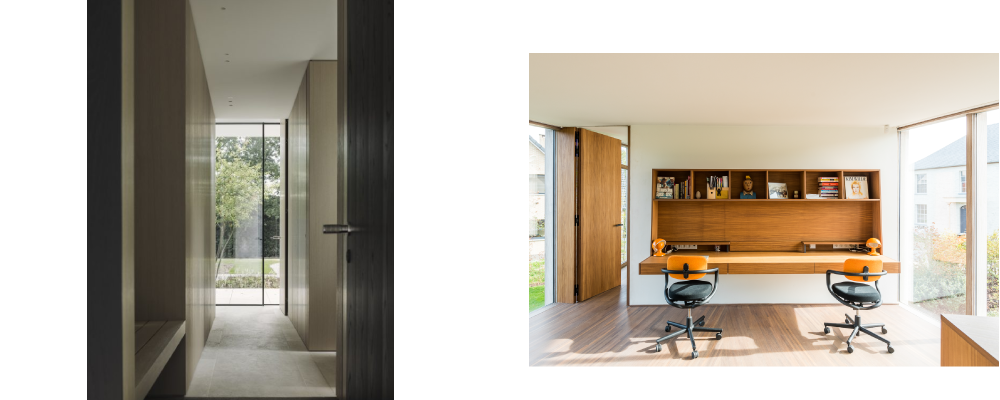
Focus-oriented spaces require acoustic environments that support concentration and speech privacy. A home library or executive study treated with acoustical plaster ceilings functions at a categorically different level than the same room with conventional finishes: reverberation is controlled, ambient mechanical noise is subdued, and the acoustic separation from adjacent spaces is improved by the contribution of the treated assembly to STC ratings.
For clients who conduct business, hold confidential calls, or simply require a functional retreat from the activity of a large household, this distinction is significant. The WELL Building Standard specifically addresses speech privacy in study and office environments, requiring treated acoustic environments to meet defined reverberation and background noise criteria. Builders working with WELL consultants will find that acoustical plaster in study and office spaces directly addresses these feature requirements.
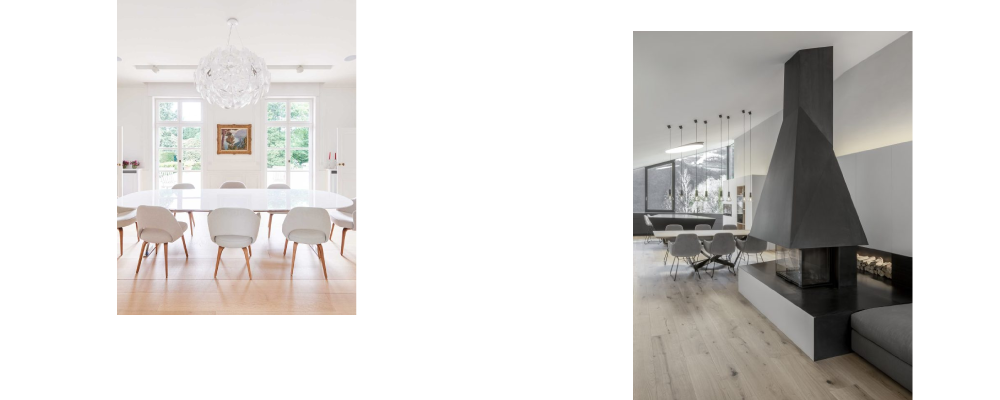
The formal dining room is one of the most acoustically neglected spaces in luxury residential design, and one where the gap between visual investment and acoustic outcome is often most pronounced. Polished stone floors, glass surfaces, and tall ceilings create a highly reflective environment in which a table of eight can generate noise levels that impair the comfortable conversation the room was designed to host.
Treating the dining room ceiling with acoustical plaster, in a finish calibrated to complement the room's visual character, brings the acoustic environment into a range where dinner conversation flows naturally at normal vocal levels. The specification is invisible; the effect on the experience of the room is not.
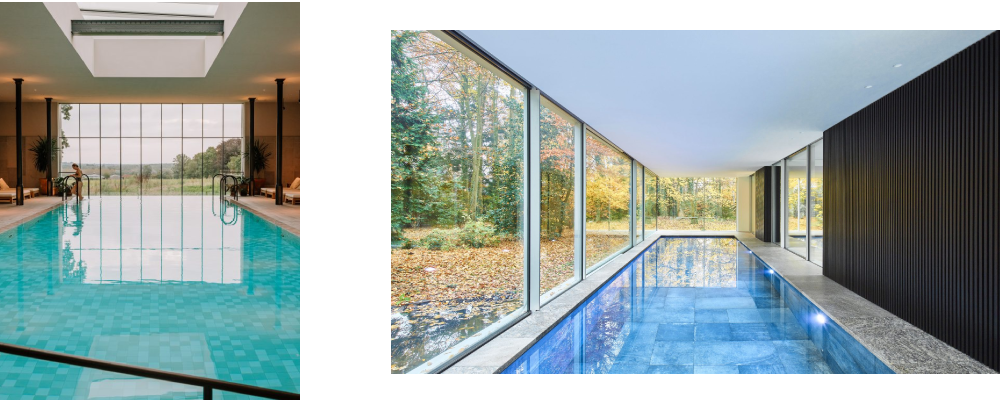
Indoor aquatic environments present some of the most severe acoustic conditions encountered in residential construction. Concrete, tile, glass, and open water are among the most acoustically reflective surfaces available, and their combination in a large enclosed volume creates reverberation times that, in untreated conditions, routinely exceed 6 to 8 seconds at the 500 Hz speech frequency. Published acoustic benchmarks for natatoriums target a reverberation time of 1.5 to 2 seconds for functional comfort. The gap between untreated condition and design target is among the largest of any interior space type.
Acoustical plaster is one of very few high-performance absorptive finish systems rated for use in humid, moisture-rich environments. The mineral wool panel and marble aggregate finish meet ASTM D3273 standards for resistance to mold growth, a critical qualification for any material installed in a spa or pool pavilion where humidity is endemic. This means the builder can resolve the acoustic conditions of an indoor pool without adding suspended baffles, fabric-wrapped panels, or other materials that would compromise the level of finish quality associated with a high-end residential aquatic space.
For spa environments, meditation rooms, and sauna suites, the acoustic case is complementary: these are spaces explicitly designed to restore calm. Their materials should support that intention at every sensory level.
The dedicated wellness room has become a standard feature of residential programs at the highest level of construction, reflecting a client understanding that physical and mental restoration require dedicated space. These rooms are, by intention, environments of radical calm. Hard surfaces, high ceilings, and minimal furnishing create a clean aesthetic while simultaneously generating the acoustic conditions most antithetical to the room's purpose: every sound in an untreated reflective room arrives at the listener multiple times, from multiple directions, making stillness perceptually difficult.
Acoustical plaster applied to the ceiling and upper walls of a meditation room or yoga pavilion resolves this without any visible treatment. The surface reads as refined plaster. The room is quiet.

Double and triple-height entry halls, open stair towers, and central atria are the acoustic distribution systems of large residences. Sound generated anywhere in the structure finds these vertical volumes and resonates, transmitting throughout the home via the connected open volumes. Treating the ceiling planes or upper walls of these spaces with acoustical plaster reduces both the reverberation within them and the acoustic energy available for onward transmission to private spaces above.
For residences in which multiple household members have different schedules and different uses of the home, this acoustic separation between levels is a practical quality-of-life specification, not a nominal one.
Stone, concrete, and masonry finishes that characterize wine cellar design are acoustically reflective by material character. A dedicated tasting room intended for intimate gatherings benefits from acoustic treatment that supports quiet conversation and allows music to be reproduced cleanly. Acoustical plaster, in a finish that can replicate the rough plaster or stone character of the surrounding environment, addresses this without visual disruption.
Explore residential applications and completed projects: baswana.com/residential and baswana.com/portfolio
Section 1: Introduction: The Missing Dimension in Residential Design
Section 2: What Acoustical Plaster Is and How It Works
Section 3: Where Acoustical Plaster Belongs in a Residence
Section 4: Design Flexibility for Surfaces That Perform and Persuade
Section 5: A Builder's Perspective to Installation, Coordination, and Timeline
Section 6: The Value Case: Immediate, Long-Term, and Lasting
Section 7: How to Introduce Acoustical Plaster into Your Specification
Connect with our skilled network of certified installers
BASWA's network of certified installers is available throughout the world. Contact the installer in your project location.
