Acoustical Plaster in Historic Preservation and Renovation
How acoustical plaster controls reverberation in historic interiors and fits preservation review: performance, finish matching, approvals, and a case study.
How acoustical plaster controls reverberation in historic interiors and fits preservation review: performance, finish matching, approvals, and a case study.
Every significant historic space carries two kinds of memory, visual and aural. The soaring nave of a 19th-century concert hall, the domed rotunda of a civic library, the barrel-vaulted ceiling of a municipal theater: each was designed with an implicit acoustic intention, even when formal acoustic science was not yet available to quantify it. When we speak of preserving these spaces, we most naturally think of ornamental plaster, gilded surfaces, leaded glass, and carved stone. The way sound moves through them, lingers, disperses, and shapes the experience of being inside them is part of the inheritance we are stewards of as well.
Yet that acoustic inheritance presents its own complications. Historic buildings were not acoustically uniform in their original state, and their later lives, including material losses, added surfaces, changed occupancy patterns, and altered programming, have typically made things more complex. A courtroom that now serves as a conference center, a ballroom repurposed for mixed-use events, a transit terminal transformed into a hotel lobby: each of these changes carries acoustic consequences that are rarely addressed comprehensively at the design stage, and are almost never reversible once decisions are made.
Acoustical plaster systems address this challenge. They let the design team change the acoustic condition of a space without sacrificing what that space represents visually and materially.
The physics of reverberation in large, hard-surfaced historic interiors is well established. Sound decays in these spaces far more slowly than speech-centered programming needs. Reverberation time (RT60), the time it takes for a sound to decay by 60 decibels after the source stops, is typically around two seconds in a concert hall and can exceed six seconds in a cathedral [1]. When speech is central, a short reverberation time keeps words intelligible; when reverberation runs long, speakers have to slow down to be understood [1]. In many historic spaces, the gap between heritage acoustic conditions and contemporary functional needs is vast.
Studies of historic worship spaces show that speech intelligibility tends to fall as reverberation time rises [2]. Spaces that were designed, or that evolved, to support unamplified music tend to have reverberation signatures that work against spoken programming, amplified or otherwise. A recent review of case studies in historic buildings reported that sound-absorbing treatments reduced reverberation times by about one to 1.2 seconds, with speech intelligibility improvements of 20 to 30 percent [2].
The diagnostic challenge for the architect or preservation professional is that each historic interior is acoustically unique. Volume, surface geometry, existing material composition, and occupancy all interact in ways that cannot be predicted without measurement and, ideally, acoustic simulation. The renovation design process should, from the outset, include acoustic measurement of the existing conditions by an acoustical consultant and acoustic modeling to understand the effect of proposed changes, including new surface treatments.
Acoustic remediation in historic buildings is not simply a matter of introducing absorptive materials. The regulatory, structural, and aesthetic constraints of preservation work create conditions that standard acoustic solutions were not designed for.
In the United States, a project with federal funding, a federal permit, or a federal license that affects a property listed in or eligible for the National Register of Historic Places, including National Historic Landmarks, goes through review under Section 106 of the National Historic Preservation Act of 1966 [3]. Many locally designated landmarks are also reviewed by a local landmarks commission. Surface treatments, ceiling alterations, and wall interventions all fall within the scope of these reviews. The design team should be prepared to show that proposed acoustic treatments are consistent with the Secretary of the Interior's Standards for Rehabilitation, which call for retaining historic character and materials, and for new work that could be removed later without harming the property's essential form [4].
Historic ceilings, particularly domed, vaulted, and coffered structures, present installation geometries that most commercial acoustic products cannot address. Suspended tile grids and standard panel systems require flat horizontal planes and structural clearances that do not exist in many of the most acoustically important historic spaces. Any intervention must conform to the existing geometry rather than impose a new one.
Existing historic plaster, whether lime-based, gypsum-based, or a combination, is often fragile after decades or centuries of thermal cycling, moisture, and vibration. Any acoustic system that requires mechanical attachment introduces risk to that substrate. BASWA panels are adhered rather than mechanically fastened at the face, and BASWA Phon can be installed directly over existing plaster that is stable. Assess the condition of the historic plaster before specifying.
The most enduring preservation objection to acoustic treatment in historic spaces is that introduced materials change the character of the interior. Drop ceilings, acoustic tiles, fabric-wrapped panels, and other standard commercial products are visually incompatible with historic interiors and are often not approvable by State Historic Preservation Offices (SHPOs) or local landmarks commissions. The acoustic solution must look like it belongs.
Acoustical plaster systems address the preservation constraint directly. Because they apply as a seamless finish to virtually any substrate geometry, including domes, vaults, complex curves, and coffers, they are formally and materially continuous with the historic plaster tradition. The finished surface reads as conventional decorative plaster, and it can be specified in any color and in multiple textures, from smooth marble-grain finishes to more articulated hand-troweled effects.
BASWA systems absorb sound through the panel and the micro-porous finish working together. Sound passes through the pores of the marble aggregate finish and is converted to heat in the panel beneath. Because acoustical plaster covers continuous surfaces rather than discrete areas, its absorption is spread across the entire treated zone.
Performance is rated using the Noise Reduction Coefficient (NRC), a single-number rating averaged from sound absorption coefficients measured at 250, 500, 1,000, and 2,000 Hz under ASTM C423, the standard test method for sound absorption in a reverberation room [5]. A higher NRC means more absorption. BASWA Phon reaches an NRC of 1.00 at 70 mm, depending on finish, according to the BASWA Phon test data sheet.
For the design team, a well-placed area of ceiling treatment, specified with a project acoustician, can meaningfully shift the reverberation of a large historic interior without filling the space with visible acoustic elements.
A BASWA system has two primary components: a sound-absorbing panel adhered to the substrate, and a micro-porous marble aggregate finish applied over it. The two work together, and the system's thickness and finish determine its absorption across frequencies. BASWA Phon is available in 30, 40, and 70 mm thicknesses, so the specifier can tune performance to the acoustic targets of the project.
The finish is 95 percent recycled marble aggregate, BASWA Phon panels contain at least 80 percent recycled glass, and the complete Phon system is 81 to 83 percent recycled content by weight. For projects pursuing LEED certification, BASWA systems can contribute to credits in several categories; the BASWA Sustainability Data Sheet has the details.
Several material properties matter in preservation work. BASWA systems score 10 out of 10 for mold resistance under ASTM D3273, which is important in humid historic environments such as natatoriums, covered courtyards, and basements. BASWA Basic is suitable in conditions up to 90 percent relative humidity and 30°C (±2°C), as detailed in the High Humidity data sheet. BASWA systems meet California Section 01350 for low VOC emissions, and a light reflectance of 89.6 to 91.3 per ASTM E1477, reported on the Phon test data sheet, keeps acoustical plaster ceilings from dulling the light in historically significant interiors.
Weight is an additional consideration in historic structures, where load tolerances may be constrained. BASWA systems weigh 1 to 2 pounds per square foot, depending on system and finish. A typical BASWA Phon installation takes four to five days with no field measurements or shop drawings required, reducing disruption to occupied or partially occupied historic properties.
The ability to customize the finish is among the most architecturally significant features of acoustical plaster for preservation work, because the acoustic treatment becomes part of the visual character of the historic space.
BASWA Colors, an integral tint additive, is mixed into the finish during installation to achieve virtually any color. Because the color is part of the plaster rather than applied to the surface, it does not bridge the micro-pores that absorb sound. Painting over a porous acoustic surface with conventional paint can significantly reduce its absorption, because the paint film bridges and seals the pores. Tint can be matched to historical paint analysis results, to the palette of adjacent historic surfaces, or to a standard color reference such as RAL, NCS, Pantone, Benjamin Moore, or Sherwin-Williams.
Finishes are available in multiple grain sizes, from smooth marble textures to coarser or rustic custom finishes. Where an adjacent historic plaster surface has a particular texture that the acoustic treatment must match, custom troweling and spray-applied methods let the installer approach that match closely. Systems can also be finished to replicate the visual quality of concrete, stone, or historic aggregate plasters. From the viewing distance of most interior spaces, the result reads as conventional historic plaster.
Bridging paints are not recommended on BASWA finishes, because they can reduce or eliminate absorption. Artisans have, however, used water-based paints to create decorative motifs over finished BASWA systems. BASWA does not make recommendations for decorative treatments, and project teams should test for any change in acoustic performance before committing to a painted program. See a case study example.
This matters most in institutional renovations where original ceiling or wall murals have been lost, damaged, or covered by earlier work. Architects of record can coordinate with decorative arts studios on a painted program over the acoustical plaster, tested first for its acoustic effect.
BASWA Shine, an acoustically transparent shimmer additive, can be added to a finished system, with effects ranging from a subtle sparkle to an intense shimmer. It comes in gold, silver, and bronze, and it needs direct sunlight or an artificial light source to show. It may suit ballroom or ceremonial spaces where the original finish had a luminous or reflective quality.
The immediate investment in acoustical plaster is the cost of the system itself, professional installation by certified installers, and coordination with the acoustical consultant and other renovation trades. Unlike conventional acoustic treatments, acoustical plaster systems do not require separate structural support systems, drywall blocking for light fixtures or diffusers, or shop drawings. Fire sprinkler heads can be integrated into the system during installation, and audio systems, including flat-panel concealed speakers, can be incorporated into the ceiling surface without visible interruption of the finish.
Acoustical plaster typically costs more per square foot than commodity acoustic tile. For historic spaces where tile is not architecturally approvable and the seamless quality of the finish is essential to meeting preservation standards, the fair comparison is with the custom or architectural acoustic solutions available to the project, and in that comparison acoustical plaster is competitive.
The acoustic improvement from a well-specified system is measurable as soon as it is installed. Shorter reverberation improves speech intelligibility [2] for the programming most renovated historic buildings host, including conferences, lectures, performances, ceremonies, and public assembly. For cultural institutions, performing arts venues, and civic spaces, that improvement shows up in the quality of the visitor's experience.
Durability makes a particularly strong case for acoustical plaster in historic renovation. A mineral plaster finish, properly applied to a sound substrate, does not degrade in the way fabric-wrapped panels or suspended tiles do, and it does not need periodic replacement. It can be cleaned with BASWA Clean, and a certified installer can repair localized damage using techniques similar to drywall repair.
For preservation project owners, this durability matches the long investment horizons typical of institutional, civic, and cultural stewardship. A surface installed as part of a major renovation in the 2020s should remain functional and visually appropriate for decades, without the cyclical replacement that commercial acoustic tile systems typically demand.
If a space's programming changes or new artwork is commissioned, a decorative painted program can be added later without replacing the acoustic system, provided it is tested first for its effect on absorption.
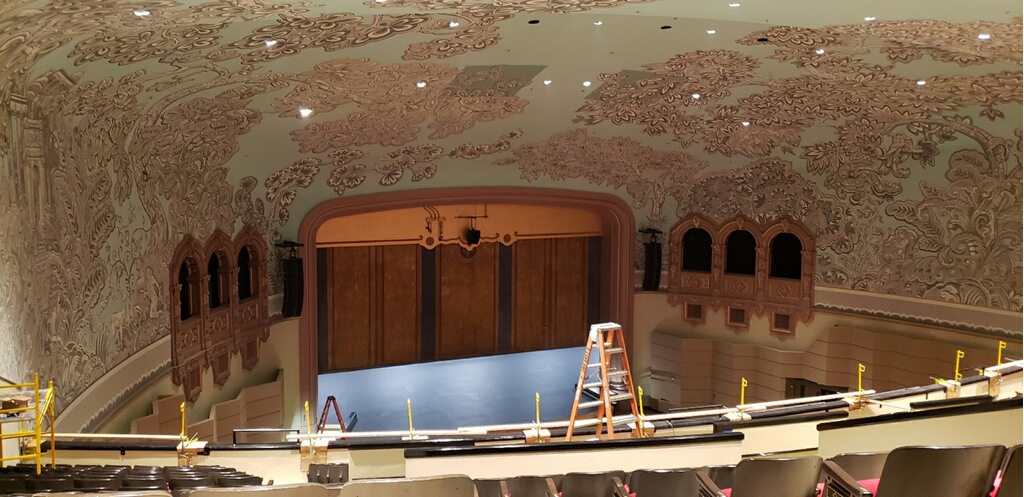
The 2016–17 renovation of Cincinnati Music Hall, a National Historic Landmark listed on the National Register of Historic Places and opened in 1878, is one of the most detailed American examples of acoustical plaster in a major historic venue. Among the renovation priorities was a better concert experience across the hall's primary performance spaces, including the barrel-vaulted ceiling of Springer Auditorium.
The renovation team identified the coffers of the barrel-vaulted ceiling and the pre-function spaces as priority zones for acoustic treatment. The material had to conform to the ceiling's existing curvature, sit seamlessly with the surrounding historic plaster, and respect the hall's Venetian Gothic character. BASWA Phon was specified for approximately 2,400 square feet of the auditorium ceiling at 30 mm, improving the room's acoustics while remaining invisible as a separate material within the historic envelope.
For a design team on a comparable project, the case shows why acoustical plaster works in historic settings. It doesn't announce itself, so the acoustic correction and the architectural character read as one surface.
Engage an acoustical consultant from the outset of the project, ideally before schematic design, to establish baseline acoustic measurements of the existing space and model the effect of proposed interventions.
Coordinate with the State Historic Preservation Office (SHPO) or local landmarks authority early to establish whether acoustical plaster is treated as a compatible treatment under the preservation standards that apply to the property.
Specify system thickness and finish with your acoustical consultant. Thickness and finish together determine performance across the frequency spectrum, so select them for the acoustic targets of the space rather than defaulting to a minimum.
Include integral color in the project finish schedule. BASWA Colors goes into the finish during installation, so the color needs to be set before work begins.
If painted decoration is part of the program, bring the decorative arts studio and the certified installer together with the architect of record, and test the paint's effect on acoustic performance before any painted work begins.
Confirm installer certification. BASWA systems are installed by trained, certified installers, and BASWA can connect the team with certified installers near the project during bidding.
Trouvez plus d’informations sur les spécifications techniques de BASWA, les options de système et les projets de rénovation historique. Obtenez des informations budgétaires spécifiques au projet ou demandez une présentation sur l’utilisation du plâtre acoustique dans les projets historiques.
The following nonprofit and public organizations champion historic preservation at national, international, and local levels. Many publish technical resources, guidelines, and standards directly relevant to renovation design.
American Institute of Architects (AIA)
Provides professional development, advocacy, and technical resources for architects, including resources on historic preservation practice and Secretary of the Interior's Standards compliance.
aia.org
National Trust for Historic Preservation (NTHP)
A leading private nonprofit advocate for historic places in the United States, chartered by Congress in 1949. Publishes the annual list of America's 11 Most Endangered Historic Places and provides education, advocacy, and on-the-ground support for threatened properties.
savingplaces.org
National Alliance of Preservation Commissions (NAPC)
Represents local preservation design review commissions across the country, providing technical support, advocacy, and a network for professionals working at the intersection of preservation and local planning.
napcommissions.org
Preservation Trades Network (PTN)
A 501(c)(3) nonprofit dedicated to supporting the traditional building trades that preserve, maintain, and restore historic buildings. Particularly relevant for projects coordinating specialist craft installation alongside acoustical plaster work.
preservationtrades.org
Connectez-vous à notre réseau expérimenté d’installateurs certifiés
Le réseau d’installateurs certifiés de BASWA est disponible partout dans le monde. Contactez l’installateur sur votre lieu de projet.
