L’acoustique, la santé et les espaces que nous appelons chez nous.
Le son est l’une des forces les plus puissantes qui façonnent notre ressenti à l’intérieur d’un bâtiment, pourtant, pendant des décennies, la conception acoustique résidentielle a été traitée comme une pensée secondaire, réservée aux studios d’enregistrement et aux salles de concert. Cette perception a changé radicalement. Un corpus scientifique évalué par des pairs en rapide expansion confirme maintenant ce que les concepteurs acoustiques comprennent depuis longtemps : l’environnement sonore à l’intérieur d’une maison gouverne directement la santé physique, la performance cognitive, le bien-être émotionnel et même la dynamique sociale des personnes qui y vivent.
Les Lignes directrices sur le bruit environnemental pour la région européenne de l’Organisation mondiale de la santé, publiées en 2018 et basées sur huit revues systématiques indépendantes, identifient le bruit environnemental comme l’une des principales menaces pour la santé physique et mentale dans l’environnement bâti, liant l’exposition au bruit chronique aux maladies cardiovasculaires, aux troubles du sommeil, aux troubles cognitifs chez les enfants et à la diminution de la qualité de vie. (1) Pour les espaces résidentiels en particulier, l’OMS recommande que les niveaux de bruit nocturne à l’extérieur des chambres ne dépassent pas 40 dB(A) en moyenne annuelle afin de prévenir l’apparition d’effets néfastes sur la santé, un seuil qui représente le « niveau d’effet indésirable le plus bas observé » pour le bruit nocturne. (2) Les sources domestiques courantes, des systèmes CVC et des appareils majeurs à la circulation infiltrant par les fenêtres et les murs, dépassent régulièrement ce seuil, faisant de la conception acoustique intentionnelle non pas un luxe, mais un élément fondamental d’une architecture résidentielle saine.
En réduisant l’exposition prolongée aux sons ambiants et réverbérants dans toute la maison, les architectes et les propriétaires peuvent réduire de manière significative le stress, protéger la santé cardiovasculaire, soutenir un sommeil plus profond, améliorer la communication familiale et préserver les conditions d’un développement sain de l’enfance. Apprenez comment fonctionnent les systèmes phoniques BASWA en milieu résidentiel.
GATHERING
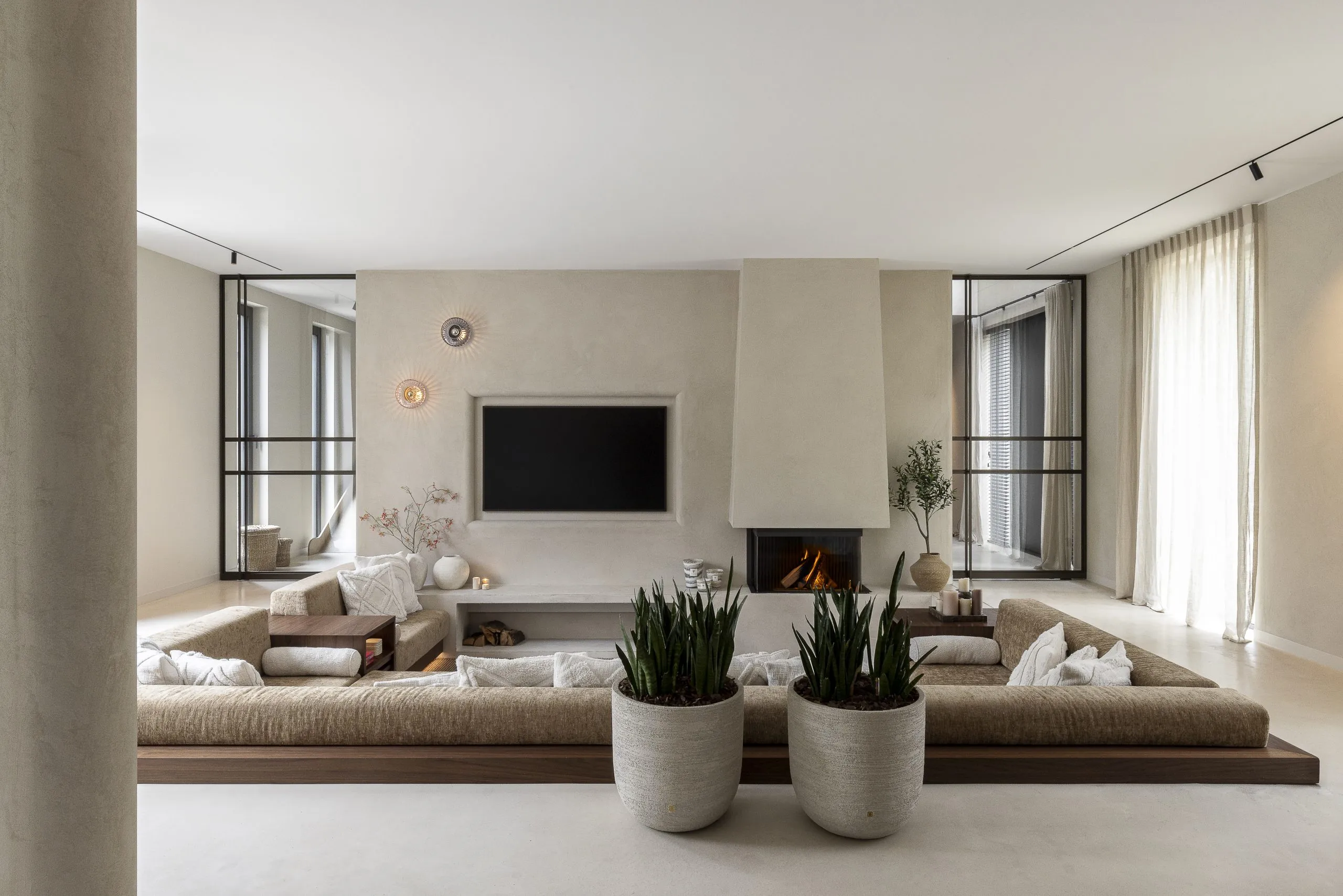
A home's shared spaces, its living rooms, great rooms, and open-plan social areas, are the acoustic environments that most directly influence the quality of family life. When multiple conversations, children at play, background media, and the ambient hum of household systems compound together, the resulting reverberation does more than simply make the room feel loud. It activates the body's stress response.
Research published in peer-reviewed literature on cardiovascular and metabolic effects of environmental noise confirms that chronic exposure to elevated ambient sound triggers measurable cortisol secretion and elevates blood pressure through vasoconstriction, effects that persist even at moderate sound levels and can occur during periods of rest. (1) In social spaces, this stress response actively undermines the human interaction these rooms are designed to support. When reverberation is reduced through sound-absorbing surfaces, speech becomes more intelligible, conversations require less effort, and the experience of gathering together becomes perceptibly more comfortable and restorative.
BASWA Phon acoustical plaster systems achieve this by allowing sound wave energy to pass through the material's microscopic pores, where it is converted into negligible heat energy and removed from the room. The result is a quieter, more intelligible acoustic environment that protects both the aesthetics and the health of the spaces where your family gathers. Explore residential project examples in the BASWA portfolio.
EATING
The dining room is one of the most sensory-rich environments in a home, and acoustics play a larger role in that experience than most people realize. Research published in the peer-reviewed journal Food Quality and Preference found that participants exposed to elevated background noise rated the sweetness and saltiness of foods as significantly less intense than those eating in quieter conditions, and perceived crunchy foods as crunchier, pointing to a direct neurological relationship between the acoustic environment and the brain's processing of taste and smell. (3) In other words, a noisy dining space does not simply make conversation harder. It actively degrades the sensory experience of the meal itself.
Whether for family dinners or entertaining guests, controlling the acoustic environment in dining spaces produces a measurable return: richer sensory engagement with food, more effortless conversation, and a setting that invites people to slow down and connect. See how BASWA systems have been applied in residential dining and entertaining spaces.
WORKING
The home office has become a permanent fixture of modern professional life. Research consistently identifies noise as among the most disruptive variables in work-from-home environments. A landmark field study published in the journal Ergonomics surveyed 88 office workers across two sites and found that 99% reported that their concentration was impaired by background noise, particularly intelligible speech from others in proximity, with no evidence of habituation to these sounds over time. (4) This "irrelevant speech effect," the well-documented cognitive phenomenon by which background speech degrades working memory and reading comprehension, is not mitigated by simply tuning it out. It is a structural problem that requires a structural solution.
For home offices and study spaces, a useful benchmark is the LEED v4.1 Acoustic Performance credit, which sets maximum reverberation times for occupied work and learning spaces to support speech clarity and concentration. (5) BASWA acoustical plaster systems absorb sound through the panel and finish together, shortening reverberation so speech in the room stays clear. Explore the technical performance data for BASWA systems.
LEARNING
Acoustic conditions in learning environments are among the most consequential variables in childhood development, and this is as true in the home as it is in a school. The American National Standard for Acoustical Performance Criteria, Design Requirements, and Guidelines for Schools, ANSI/ASA S12.60, set the long-standing benchmark in its 2010 edition: background noise in core learning spaces should not exceed 35 dB(A), and reverberation time in classrooms smaller than 283 m3 should not exceed 0.6 seconds. A revised edition, S12.60-2026, has since been published. (6)
A systematic review of research on speech intelligibility in elementary classrooms found that long reverberation times and high background noise reduce how well children understand speech. (7) In the home, study spaces, homework rooms, and home-schooling environments that exceed these acoustic thresholds place children at a measurable disadvantage. BASWA Phon systems can be specified in residential learning spaces to bring reverberation and ambient noise within ranges that actively support speech perception and deep comprehension. Learn more about BASWA's educational CEU resources.
RESTING
Sleep is perhaps the domain where acoustic design has its most direct, measurable impact on health. The WHO's Night Noise Guidelines for Europe establish 40 dB(A) as the nighttime noise threshold at which the lowest observed adverse health effects begin, and recommend an annual average outdoor noise level below this limit to protect the public, including particularly vulnerable groups such as children, the elderly, and the chronically ill. (2) At levels above 55 dB(A), cardiovascular effects become the predominant public health concern. (2)
A 2022 systematic review and meta-analysis updating the WHO's evidence found that transportation noise at home is associated with worse self-reported sleep, and that people exposed to high levels of aircraft noise may be at greater risk of sleep disturbance than previously estimated. (8) The bedroom is therefore not simply a room for rest. It is an environment that, when acoustically treated correctly, actively preserves cardiovascular health, metabolic function, immune resilience, and cognitive performance.
BASWA Phon systems are particularly effective in bedroom applications, where their seamless, monolithic marble finish integrates invisibly into the architecture while delivering meaningful reductions in reverberation time and ambient noise levels. Explore bedroom and high-humidity applications.
OUTSIDE
As urban populations grow and city centers densify, exterior noise exposure has become an increasingly significant public health challenge even in spaces intended for rest and outdoor living. The WHO's 2018 Environmental Noise Guidelines note that outdoor spaces and residential facades are on the front line of noise exposure, and that the cardiovascular and metabolic effects of environmental noise, including from road, rail, and aircraft sources, pose systemic risks for communities near major infrastructure. (1) According to the European Environment Agency, long-term exposure to environmental noise contributes to approximately 48,000 new cases of ischemic heart disease in Europe annually. (9)
For residential projects that incorporate covered outdoor living areas, natatoriums, pool rooms, or loggia, BASWA Phon systems are formulated to perform in high-humidity environments at up to 95% relative humidity, delivering seamless acoustical treatment that reduces reflective noise buildup in outdoor-adjacent spaces. The durable, mold-resistant marble finish coat also reflects natural light, further contributing to the sensory quality and wellbeing of these environments. Review BASWA's technical specifications for high-humidity and outdoor applications and explore the full BASWA product range.
Série Healthy Architecture
Créer une architecture saine
Comment l’architecture moderne crée des espaces sains pour le bien-être humain
Trouver le confort acoustique
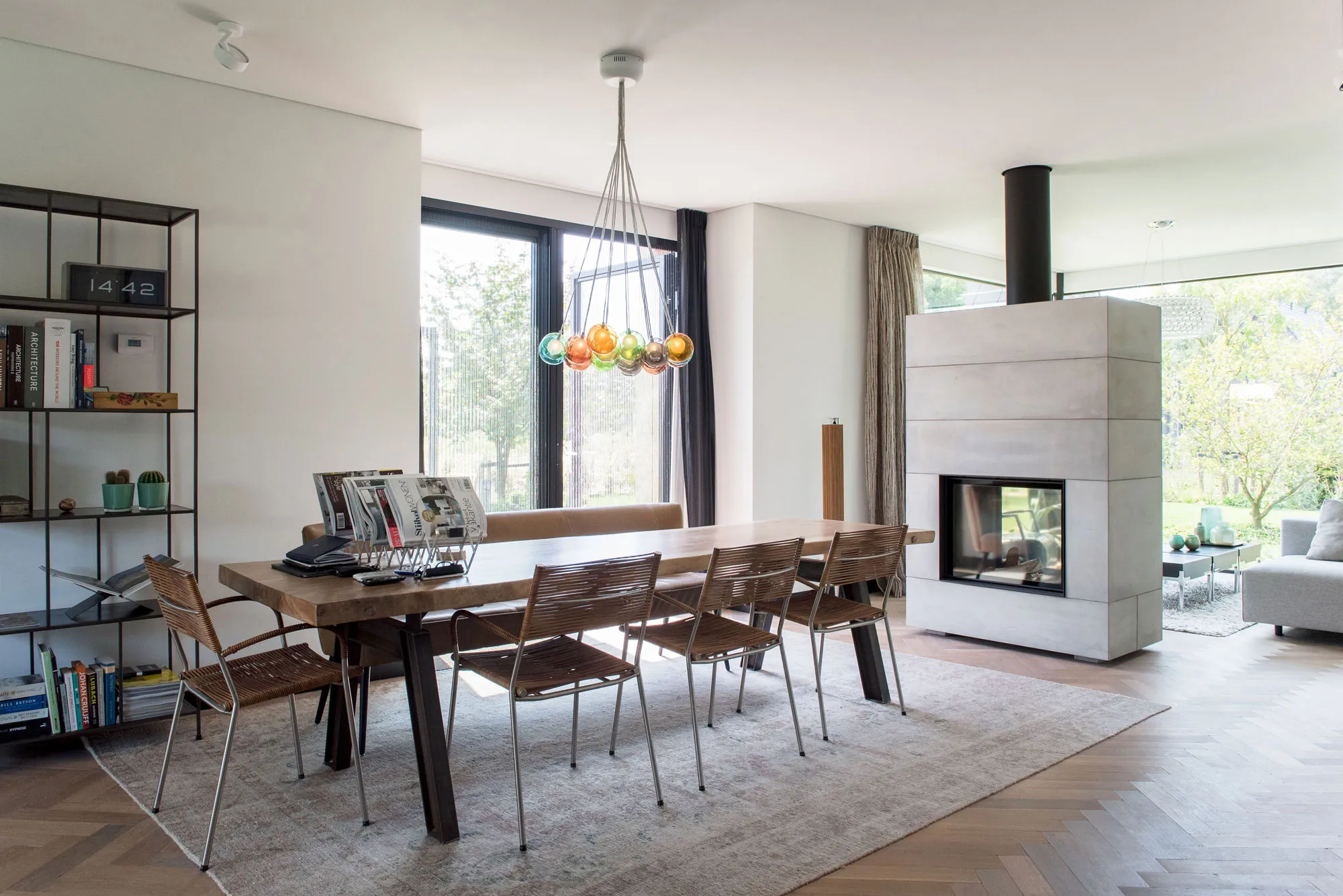
« Considérer une architecture saine et exclure le son dans cette image reviendrait à omettre un de nos sens principaux nécessaire pour nous sentir à l’aise. » - Scott Pfeiffer, FASA, associé chez Threshold Acoustics
L’absorption sonore fonctionne en réduisant le temps de réverbération dans un espace. La réverbération est la persistance du son réfléchi après que sa source s’est arrêtée, causée par des ondes sonores rebondissant sur des surfaces dures, parallèles ou concaves. Dans les pièces à forte réverbération, chaque source sonore, conversation, appareil, système CVC ou bruit ambiant provenant de l’extérieur est amplifié et prolongé, ce qui crée un environnement acoustiquement stressant qui dégrade l’intelligibilité de la parole, perturbe la concentration et impose un fardeau physiologique mesurable à ses occupants.
Le plâtre absorbant phonique BASWA Phon est un système acoustique appliqué sur le terrain sans couture qui atteint certains des taux de réduction du bruit (NRC) les plus élevés de tous les plâtres acoustiques sur le marché, avec des valeurs atteignant 1,00 et plus, testés et confirmés indépendamment. En absorbant l’énergie sonore à haute fréquence par des pores microscopiques à la surface finie et en captant l’énergie basse fréquence par une action diaphragmatique contre le panneau de laine minérale, BASWA Phon obtient une absorption sonore à large bande sans nécessiter de tuiles suspendues de plafond, de panneaux acoustiques visibles ou tout traitement compromettant l’intégrité architecturale d’un espace.
Les systèmes BASWA Phon peuvent être appliqués sans effort à un large éventail d’applications résidentielles, notamment :
- Environnements à forte humidité (piscine et salles de spa)
- Salles familiales
- Salles de projection et de musique
- Salles à manger
- Chambres
- Études et bureaux locaux
Because the BASWA system is customized to any color and texture through BASWA Colors tint additives and applied by Certified Installers trained directly by BASWA acoustic, the finished surface is indistinguishable from conventional plaster, protecting the design intent of the space entirely. In addition to its acoustic performance, BASWA Phon is manufactured from up to 95% natural and recycled materials, contains no VOCs, meets California Section 01350 standards for indoor air quality, and carries a Class A fire rating, making it an ideal specification for architects pursuing LEED v5 Acoustic Performance credits or other sustainability certifications.
The decision to address acoustics through BASWA Phon is not simply an investment in sound. It is an investment in the long-term health, wellbeing, and quality of life of everyone who lives within those walls.
For more information about BASWA acoustic sound absorbing, monolithic plaster systems for residential and commercial applications, contact us or explore our portfolio of completed projects. Architects and design professionals can also access continuing education resources and LEED-relevant technical documentation.
See BASWA systems in action across commercial and residential settings. For more information about BASWA acoustic sound absorbing, monolithic, marble finishes, contact us.
References
(1) World Health Organization Regional Office for Europe. Environmental Noise Guidelines for the European Region. Copenhagen: WHO, 2018. https://www.who.int/europe/publications/i/item/9789289053563
(2) World Health Organization Regional Office for Europe. Night Noise Guidelines for Europe. Copenhagen: WHO, 2009. Summarized in: Journals of Noise and Health 2010; 12(47):60-65. https://journals.lww.com/nohe/fulltext/2010/12470/summary_of_night_noise_guidelines_for_europe.2.aspx
(3) Woods, A.T., Poliakoff, E., Lloyd, D.M., Kuenzel, J., Hodson, R., Gonda, H., Batchelor, J., Dijksterhuis, G.B., and Thomas, A. "Effect of background noise on food perception." Food Quality and Preference 22(1), 2011: 42-47. https://doi.org/10.1016/j.foodqual.2010.07.003
(4) Banbury, S.P. and Berry, D.C. "Office noise and employee concentration: Identifying causes of disruption and potential improvements." Ergonomics 48(1), 2005: 25-37. https://doi.org/10.1080/00140130412331311390
(5) U.S. Green Building Council. LEED v4.1 BD+C and ID+C Credit: Acoustic Performance (EQc9). USGBC, 2022. https://www.usgbc.org/credits/
(6) Acoustical Society of America. ANSI/ASA S12.60-2010 (R2020): Acoustical Performance Criteria, Design Requirements, and Guidelines for Schools, Part 1: Permanent Schools. Melville, NY: ASA. Revised as ASA/ANSI S12.60-2026/Part 1. https://asastandards.org/store-home/
(7) Murgia, S., et al. "Systematic Review of Literature on Speech Intelligibility and Classroom Acoustics in Elementary Schools." Language, Speech, and Hearing Services in Schools, 2023. https://pubs.asha.org/doi/10.1044/2022_LSHSS-21-00181
(8) Smith, M.G., Cordoza, M., and Basner, M. "Environmental Noise and Effects on Sleep: An Update to the WHO Systematic Review and Meta-Analysis." Environmental Health Perspectives 130(7), 2022: 076001. https://pmc.ncbi.nlm.nih.gov/articles/PMC9272916/
(9) European Environment Agency. Health Risks Caused by Environmental Noise in Europe. EEA Briefing No. 10/2020. Copenhagen: EEA, 2020. https://www.eea.europa.eu/en/analysis/publications/health-risks-caused-by-environmental-noise-in-europe
